Programme
Meetings are normally held at the Battle Memorial Hall, generally on the third Thursday of each month at 7.30 pm, but please check the programme as there are exceptions.
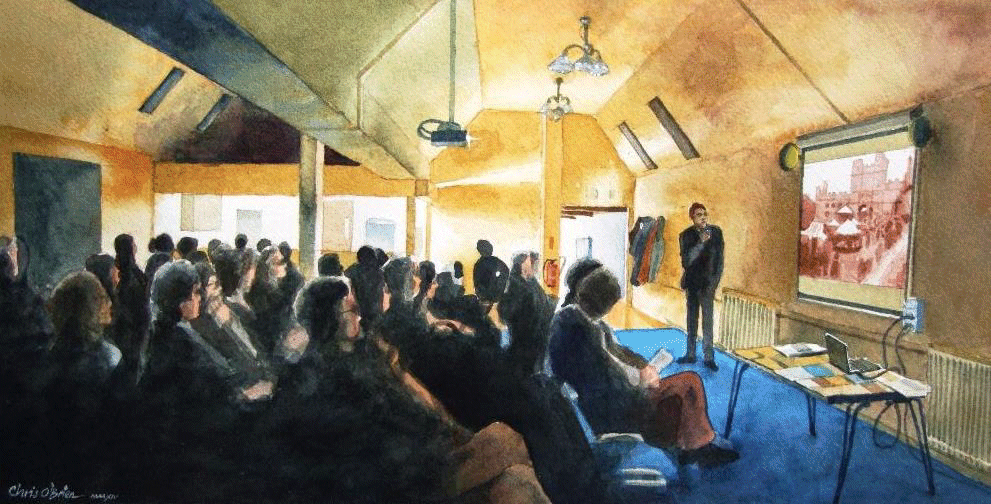
Painting of a BDHS lecture in progress in the Wynne Room by Chris O’Brian © BDHS

2026-27 Season
Accidental Death in Tudor England
Date: 17 Sept 2026
Start time: 7:30 PM
End time: 9:30 PM
Tudor England was a dangerous place. There were plagues, wars, perilous childbirths and shocking infant mortality but what about the risks in people’s everyday lives? There were dangers in the workplace, housework and even leisure activities such as football, swimming, bell-ringing, river-side flower picking and even getting too close to performing bears!
A lecture to be given by Professor Steven Gunn
Matilda and England’s Eleventh Century Queens
Date: 15 Oct 2026

Start time: 7:30 PM
End time: 9:30 PM
The lecture will focus on the life of Queen Matilda, both as duchess of Normandy and queen of England and as the wife of William the Conqueror. Given that we know so much about Queen Emma and Queen Edith, it will also be comparative and a reflection on queenship and women’s history.
Commemoration Lecture to be given by Professor David Bates
Gunpowder Plot: Fake News?
Date: 19 Nov 2026
Start time: 7:30 PM
End time: 9:30 PM
Come and find out what really happened in the run-up to the Gunpowder Plot on 5 November 1605. It is integral to the subsequent arrest and torture of Nicholas Owen SJ and Father Henry Garnet (then the Jesuit Superior in England).
A lecture to be given by Meyrick Simmonds
Members Only : Christmas Event
Date: 17 Dec 2026
Start time: 7:30 PM
End time: 9:30 PM
A Christmas event, open to members only.
The Norman Conquest’s Importance to English Law
Date: 21 Jan 2027
Start time: 7:30 PM
End time: 9:30 PM
The Conquest was one of the most consequential events in English history.The subsequent Norman settlement of England had wide-ranging effects on the later development of all aspects of political and social life: most intimately on the pre-Conquest legal system. This, in part, was because King William justified his seizure of the English throne in English terms. After the event at Hastings, William claimed he was simply fighting for his rightful claim to be the heir of Edward the Confessor. This fiction was to undergird much of what the Normans later did and was the keystone of their subsequent constitutional edifice. The consequences of the Conquest and its justification are still apparent in the Anglo-American legal tradition of “common law” today.
A lecture to be given by Tom McAuliffe
The Arts and Crafts Movement and its Gardens
Date: 18 Feb 2027
Start time: 7:30 PM
End time: 9:30 PM
The Arts and Crafts garden is thought to be the ideal English garden design. Stephen explains how this is not the case as the movement has its roots buried deep in the Italian Renaissance and the gardens of Persia, as well as in the medieval period. He explains how the quintessentially English garden is a figment of the imagination. He also discusses the ingredients of what make an Arts and Crafts Garden. At the end of the talk, Stephen looks at how the Great War impacted on the movement and to this day set the scene for future garden design.
A lecture to be given by Stephen Harmer
70th anniversary of the 1957 Treaty of Rome: Did all roads lead to Rome?
Date: 18 Mar 2027
Start time: 7:30 PM
End time: 9:30 PM
Explaining the emergence of the EC/EU and Britain’s initial non-involvement. Why were the Six able to agree on the Treaty of Rome, especially after the European Defence Community disaster? And what role did those not present, notably Britain, play in their success?
The Richard Moore Memorial Lecture to be given by Professor Piers Ludlow
How to Dissolve a Monastery
Date: 15 Apr 2027
Start time: 7:30 PM
End time: 9:30 PM
Monasteries formed a cornerstone of medieval religion and society. Yet, in barely five years, each of the England’s 850 religious houses were closed with dramatic and long-lasting consequences for the whole of society. The popular narrative dwells on Henry VIII and Thomas Cromwell: greedy king and grasping courtier. But there must be more to it than that? How do you actually dissolve a monastery and get away with it? This is a story of high politics and low deals, well intentioned reforms and off the cuff government policy that rapidly spiralled out of control.
A lecture to be given by James Witcombe
Extra Event : Excavating the Roman Road at Icklesham
Date: 29 April 2027
Start time: 7:30 PM
End time: 9:30 PM
Recent excavations on his land at Icklesham have revealed evidence of continuous occupation from the Bronze Age to mediaeval times. Geophysical investigation indicated an undiscovered Roman road, which has now been excavated by volunteers from the Winchelsea Area Archaeology and History Society under the direction of a professional archaeologist. It is very evident that history of this particular area cannot be understood without an understanding of its geography: namely the former intertidal area.
A lecture to be given by Philip Merricks MBE DL
Want to be involved in the dig? Attend the lecture and hear how to sign up!
“Gentlemen, Farmers and Tradesmen and the Labouring Poor”
Date: 20 May 2027
Start time: 7:30 PM
End time: 9:30 PM
A Glimpse of Life in 18th Century Brightling: This presentation will reveal how a chance discovery led to a unique insight into life in Brightling at the time of Mad Jack Fuller.
The Springfield Memorial Lecture to be given by members of the BDHS Research Group
The Wilton Diptych: The Treasure itself and its Influence on Shakespeare
Date: 17 Jun 2027
Start time: 7:30 PM
End time: 9:30 PM
Diptych is one of the National Gallery’s most mysterious treasures. A very rare medieval survivor of the iconoclasm of the Reformation, this richly ornamented panel shows King Richard II, supported by three saints, kneeling before the Virgin Mary who is surrounded by an angelic host. Dr Mary Hersov will discuss the story of the image and what it reveals about Richard II’s idea of kingship.
Themes of kingship were scrutinised by Shakespeare in his play Richard II. Charlotte Moore will explore the theory that Shakespeare was directly influenced by the Diptych, especially in John of Gaunt’s famous “sceptred isle” speech.
A lecture to be given by Dr Mary Hersov & Charlotte Moore
Bringing the Bayeux Tapestry Home
Date:15 Jul 2027
Start time: 7:30 PM
End t
ime: 9:30 PM
This event will be held in the Duke’s Library at Battle Abbey School – with a reception beforehand at 6.30pm on the Terrace overlooking the battlefield. It will be ticketed, but free to members.
Exhibiting the Bayeux Tapestry at the British Museum provides a once-in-a-lifetime opportunity to see the embroidery in London. Michael Lewis, Curator of the exhibition, will provide insights into the exhibition’s planning, its aims and objectives, and reflect on the experience
A lecture to be given by Professor Michael Lewis
2026-27 Lecturers
Steven Gunn :
Professor Steven Gunn a fellow of Merton College, Oxford and is a specialist in late medieval and early modern Britain and Europe. As well as researching into accidental death and everyday life, he has published works on Tudor government, warfare, foreign policy and political culture and the comparison of the English state in this period with other in Europe.
Return to Programme
David Bates :
Professor David Bates is President of BDHS and Emeritus Professor in Medieval History at the University of East Anglia. He is a recognized expert on the 10th to 13th centuries, specializing in the history of Britain and France, particularly the Norman Conquest.
Return to Programme
Meyrick Simmonds :
Meyrick lives in Guernsey and is a frequent visitor to Ninfield. He is a retired RN officer rather than an academic. He has written an as-yet unpublished biography of the life of St Nicholas Owen S.J, a Jesuit lay brother who was a genius at building priest hides between 1588 and 1605.
Return to Programme
Tom McAuliffe :
Tom is a Postdoctoral Member of the History Faculty at the University of Oxford. His doctoral thesis was about the transmission and use of abbreviations and copies of the Domesday Book. He is interested in English manuscripts and their use after the Norman Conquest; another of his projects is about the medieval climate and its effects on politics and society.
Return to Programme
Stephen Harmer :
Stephen has an MA in Garden History and is a qualified Lecturer. He has taught horticulture and garden history for Hadlow College, Plumpton College, The University of Greenwich, and the RHS at Wisley. Stephen is a garden historian and teaches this subject. He is a speaker, historian and author. His book, La Chaire: The Story of Jersey’s Lost Garden, has sold well. Stephen also wrote a successful series on historic gardens and styles for ‘Garden Design Journal’. Stephen also leads tours to gardens in the UK and Europe.
Return to Programme
Piers Ludlow :
Professor Piers Ludlow studied for his undergraduate degree at Trinity College, Oxford before moving on to St Antony’s College, Oxford to study for his D.Phil. He was then a British Academy Postdoctoral Fellow at Balliol College, Oxford until he joined LSE in 1998 where he is a professor in the Department of International History. His main research interests lie in the history of Western Europe since 1945, in particular the historical roots of the integration process and the development of the EU. His current research priority involves assessing and analyzing Britain’s 40 plus years as a member of the European Community/Union – from the beginning until 2016. This will hopefully add depth and perspective to the current debate about Brexit and allow a clearer appreciation of how membership affected both the UK itself and the EC/EU more widely – and hence how both will be altered by the end of this membership.
Return to Programme
James Witcombe :
James works for English Heritage as manager of Battle Abbey. After studying history at the University of Exeter, he embarked on a career in heritage. With a wide range of historical interests, his passion for monastic history was developed at an early age on family holidays exploring ruined abbeys.
Return to Programme
Philip Merricks :
Philip Merricks MBE DL is the owner of the Elmley and Romney Marsh nature reserves and a noted farmer and conservationist. He served on the Executive Committee of the Romney Marsh Research Trust for more than twenty years – a multi-disciplinary organisation whose research projects included historical studies, archaeology, geology, topography and study of documentary records resulting in sixty peer-reviewed research papers published by OUP in four separate monographs.
Return to Programme
Mary Hersov and Charlotte Moore :
Dr Mary Hersov is a freelance art historian. She worked at the National Gallery for thirty years, eventually becoming Head of Exhibitions, then Head of National Programmes. Back in 1994, she was an exhibition organiser for the National Gallery’s show Making and Meaning: the Wilton Diptych. and she has been fascinated by this unique and precious object ever since.
Charlotte Moore took degrees in both English Literature and the History of Art, so this topic combines the two. Shakespeare is her special interest; she runs a weekly Shakespeare study group via Zoom.
Return to Programme
Michael Lewis :
Professor Michael Lewis is the Head of Portable Antiquities & Treasure at the British Museum and Curator of the upcoming Bayeux Tapestry exhibition. He is also a Visiting Professor in Archaeology at the Universities of Reading and Exeter.
Return to Programme